


How Hotels Can Get More (and Better) Guest Reviews

Reputation Management
All Your Reviews In One Place
Track Reviews & Feedback, Collect More Reviews, Prevent Poor Reviews, Guest Feedback, Analytics & Reporting, Respond to Reviews with guestAI or with our Dedicated Team, Reviews Widget for Website, PMS Automations and more.
Book a Quick 15-minute Call for a Customized Setup. We personalize your trial by understanding your brand's unique goals during a quick call.
Guest Messaging Platform
Transform Guest Communication & Revenue with an All-in-One Platform
Seamless Guest Communication and Engagement: From Pre-arrival to Check-out
Book a Quick 15-minute Call for a Customized Setup. We personalize your trial by understanding your brand's unique goals during a quick call.
Review Responses
Done For You
Handcrafted, Personalized Responses to Your Online Reviews. Done for You.
Book a Quick 15-minute Call for a Customized Setup. We personalize your trial by understanding your brand's unique goals during a quick call.
Request Free Trial
Book a Quick 15-minute call
We personalize your trial by understanding your brand's unique goals during a quick call.
%20Guest%20Reviews.jpg)
Most hotels treat reviews like a request. Checkout happens, an email goes out, and the team hopes for the best.
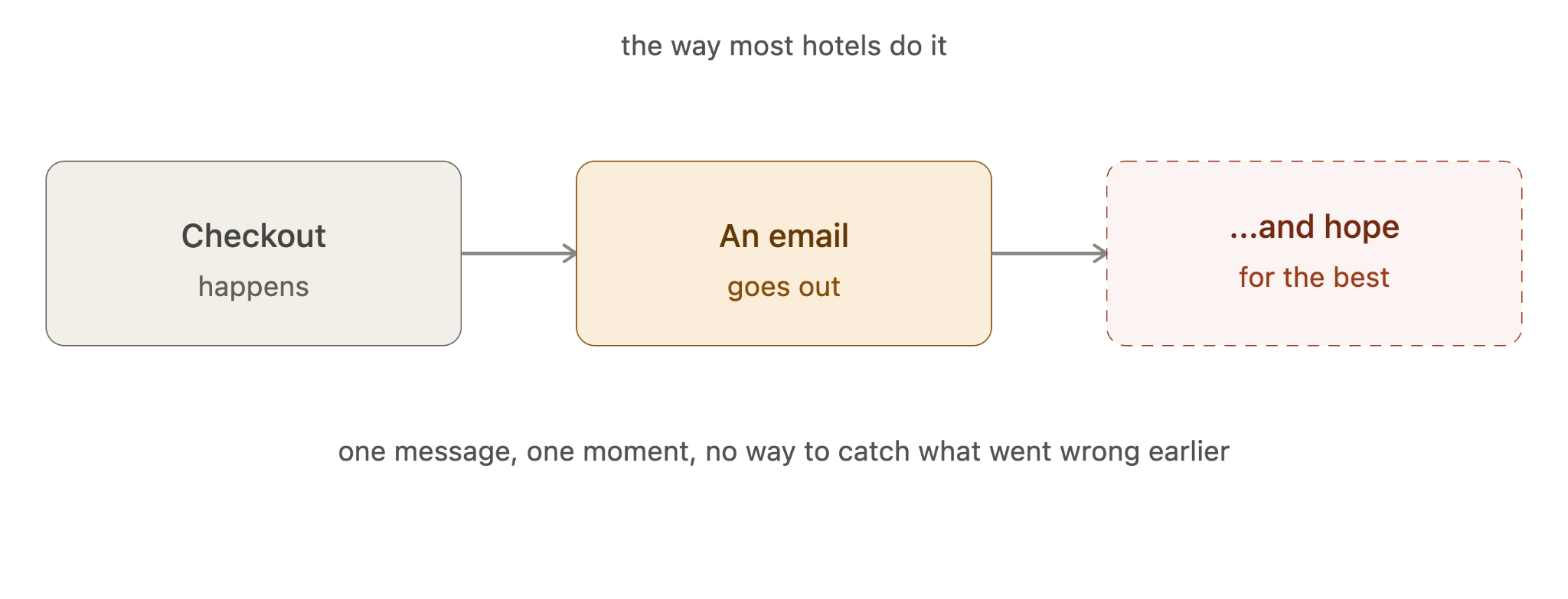
But the properties that consistently rank higher and convert more direct bookings aren't better at asking, they're better at building a system. Great reviews aren't the result of one well-timed email. They're the output of everything that happened before that email was ever sent.
This guide walks through what that system actually looks like, step by step, and where most hotels go wrong trying to build it.
Why "Just Ask for Reviews" Doesn't Work Well
A single post-stay email can only do so much. If a guest had a rough stay, no amount of clever subject-line copy will turn that into a five-star review — and pushing too hard for a review from an unhappy guest often backfires, since it gives them a fresh reason to write about the frustration.
The hotels getting ahead of this treat review generation as a full-journey process: catching problems early, addressing them while the guest is still onsite, and only then asking for public feedback, from guests who are actually in a position to give a great one.
Step 1: Catch Problems Before They Become Reviews
Every hotel already has a signal for what's dragging down guest satisfaction. It's just usually buried across hundreds of recent past reviews instead of surfaced as an active feed.
Deep sentiment signals analysis with nuance pulls recurring themes out of guest feedback — cleanliness, noise, check-in speed, staff friendliness, and shows you which ones are actually moving your score, rather than which ones simply come up most often. If cleanliness complaints are quietly dragging your average down even though most guests never mention it directly, that's the kind of pattern a sentiment report catches and a spreadsheet of star ratings won't.
GuestTouch's Sentiment Signals go a layer deeper: not just flagging that staff came up in complaints, but separating what kind of staff issue it was, rudeness versus slow response time versus something else entirely, each of which needs a completely different fix. The same nuance applies across categories, distinguishing what's actually driving guest frustration from what's driving genuine satisfaction, so you're fixing the precise thing instead of the loudest thing.
The key shift here: this isn't a one-time audit. It's a continuous loop of reading signals. As operations improve, the next set of reviews reflects it, and the sentiment data updates again, which is what makes it worth checking daily/weekly rather than only after a bad quarter.
Step 2: Use In-Stay Feedback Carefully
In-stay feedback, checking in with guests mid-stay, before checkout, is one of the highest-leverage tools available, as service recovery experience can boost the satisfaction, and also one of the easiest to get wrong.
Done well, it catches a problem while there's still time to fix it. A guest mentions the room is too warm, housekeeping adjusts it within the hour, and that guest now has a genuinely better story to tell than if nothing had gone wrong at all.
Done poorly, it creates a paper trail. If a guest flags an issue mid-stay and nothing happens before checkout, you've now got documented proof the property knew and didn't act, and that shows up in the review, often word for word. So do make sure you have operational SOP to handle the in-stay situation.
The fix isn't avoiding in-stay feedback. It's pairing it with a real operational commitment: a clear owner for each type of issue, a fast response window, and a way to close the loop with the guest so they know it was handled, not just that it was received.
GuestTouch makes this seamless by sending a quick, well-timed check-in, via WhatsApp, SMS, or email, whichever fits the moment in the guest's journey at the right time, so a dedicated team member can catch the sentiment signal early and turn it into a win before checkout ever happens.
Step 3: Let the Post-Stay Survey Do the Routing
By the time a guest checks out, you should already have a good sense of how their stay went, which is exactly why the post-stay survey shouldn't treat every guest the same way.
A smart survey routes based on sentiment: happy guests get a direct, one-click path to leave a public review on the channel that matters most to you (Google, a specific OTA, wherever drives the most value). Unhappy guests are also given the opportunity to share feedback through an internal channel where it becomes a signal for the team to act on.
This does two things at once. It makes it seamless for guests to leave a quick review if they are pleased with the stay and for unhappy guests, and it still captures their feedback as useful, actionable data instead of losing it entirely.
Putting It Together: What a Full System Looks Like
None of these three steps work as well in isolation as they do connected.
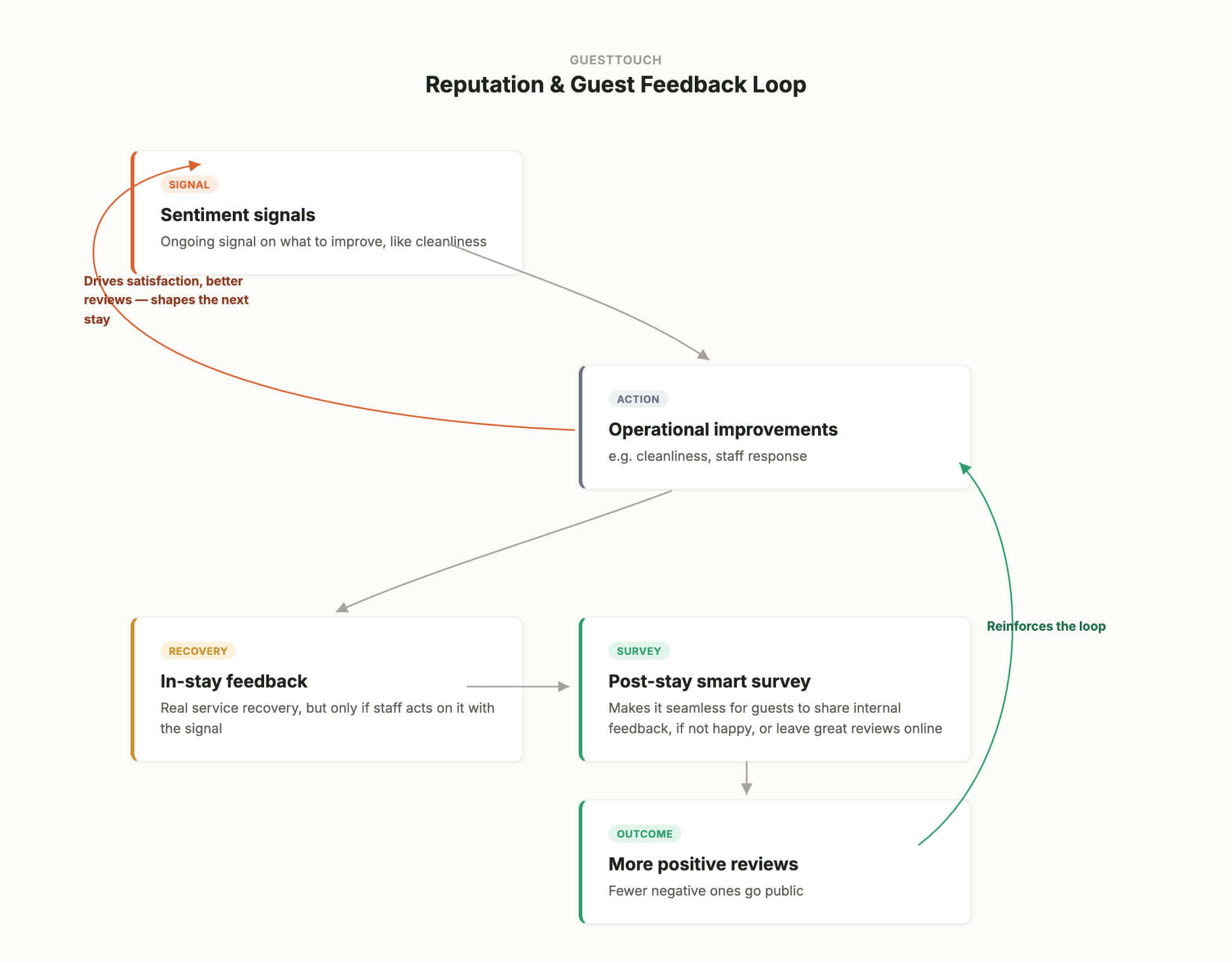
Sentiment signals, active reports and the post-stay feedback all feed the same thing: a continuous read on what's working and what isn't, which shapes operational decisions for the next guest, not just the current one. In-stay feedback sits in the middle as the real-time bridge, the moment where a problem either gets caught and fixed, or gets carried all the way to a public review.
Picture it as a loop, not a funnel: sentiment data signals and informs operations, operations improve the stay, the post-stay survey captures the result and feeds it back in, and the cycle repeats, generating great reviews that drive higher occupancy, support higher ADR, and ultimately lift revenue.
Quick-Start Checklist
If you're building or auditing this system at your property, a few concrete things to check:
- Response SLA: Is there a defined, fast turnaround time for in-stay feedback (same-day, not "when someone gets to it")?
- Closed-loop confirmation: Does the guest actually hear back that their issue was addressed?
- Routing logic: Does your post-stay survey make it seamless for your guests to public channels and allow unhappy guests to leave a quick feedback?
- Review cadence: Is someone getting the sentiment trends and signals proactively, not just reacting to a bad review when it lands?
- Ownership: Does every flagged issue have a clear person or team responsible for resolving it?
The Takeaway
Getting more great reviews isn't just about a better ask at checkout. It's about building a system that just works and catches problems early, gives your team a real chance to fix them, and only asks for public feedback from guests who are actually ready to give it.
Platforms like GuestTouch's Reputation & Guest Feedback tools are built around exactly this loop, surfacing deep sentiment signals for the right team, enabling in-stay service recovery, and routing post-stay surveys automatically, but the framework matters more than any single tool. Start with the checklist above, and build from there.


Need Help ?
Talk to our Experts to supercharge your Pre-Arrival experience
Schedule Now
Posted on
August 1, 2026
Referenced GuestTouch Products
No items found.
AI generated responses for your reviews
Powered by Review Response AI

Get bright ideas and best practices delivered straight to your inbox
Stay up to date! Get all the latest & greatest posts delivered straight to your inbox
Don’t worry we won’t send you spam