


Beyond the Combined Dashboard: A Reputation Blueprint for Multi-Property Hotel Groups in the Age of AI

Reputation Management
All Your Reviews In One Place
Track Reviews & Feedback, Collect More Reviews, Prevent Poor Reviews, Guest Feedback, Analytics & Reporting, Respond to Reviews with guestAI or with our Dedicated Team, Reviews Widget for Website, PMS Automations and more.
Book a Quick 15-minute Call for a Customized Setup. We personalize your trial by understanding your brand's unique goals during a quick call.
Guest Messaging Platform
Transform Guest Communication & Revenue with an All-in-One Platform
Seamless Guest Communication and Engagement: From Pre-arrival to Check-out
Book a Quick 15-minute Call for a Customized Setup. We personalize your trial by understanding your brand's unique goals during a quick call.
Review Responses
Done For You
Handcrafted, Personalized Responses to Your Online Reviews. Done for You.
Book a Quick 15-minute Call for a Customized Setup. We personalize your trial by understanding your brand's unique goals during a quick call.
Request Free Trial
Book a Quick 15-minute call
We personalize your trial by understanding your brand's unique goals during a quick call.
How growing multi-property hotel groups use the AI-powered Adaptive Reputation Engine to outperform their comp set, protect portfolio revenue, and keep every team aligned — on every corner.

Do you want to know the secret to increasing your hotel room rates by up to 11% without losing a single booking?
It’s not a million-dollar lobby renovation. It’s not a massive marketing campaign.
According to data from Cornell University, it comes down to a single metric: a 1-star increase in your online reputation score.
For a single hotel, that math is exciting. But if you manage a portfolio of five, twenty, or a hundred properties, the numbers become staggering.
Dropping from a 4.4 to a 3.9-star average across your portfolio represents hundreds of thousands of dollars in uncaptured revenue leaking out of your business every single month.
Running reputation management for an independent hotel brand or a rapidly growing hotel management company is a completely different game than managing a single property. Most management companies discover this the hard way right around property number three or four.
That’s when the single-property SaaS tool that your GM used to love completely stops performing as it should in an age of AI
The platform doesn’t break all at on
e. It just quietly starts costing you: fragmented logins, missed review responses, and manual reporting that takes your team days to stitch together.
Worse, legacy platforms are incredibly heavy, clunky, and packed with jargon. They force your hospitality teams to act like data analysts instead of hotel operators.
If you want to scale your portfolio today, you don’t need more software overhead or another platform you have to babysit.
You need a frictionless system purpose-built to deliver operational insights from guest reviews at the property, regional, and portfolio level simultaneously.
Let’s look at exactly why legacy tools fail at scale — and how GuestTouch built a framework to fix it.
The Threshold of Complexity: Why Multi-Unit Portfolios Can’t Be Managed Like Single Assets
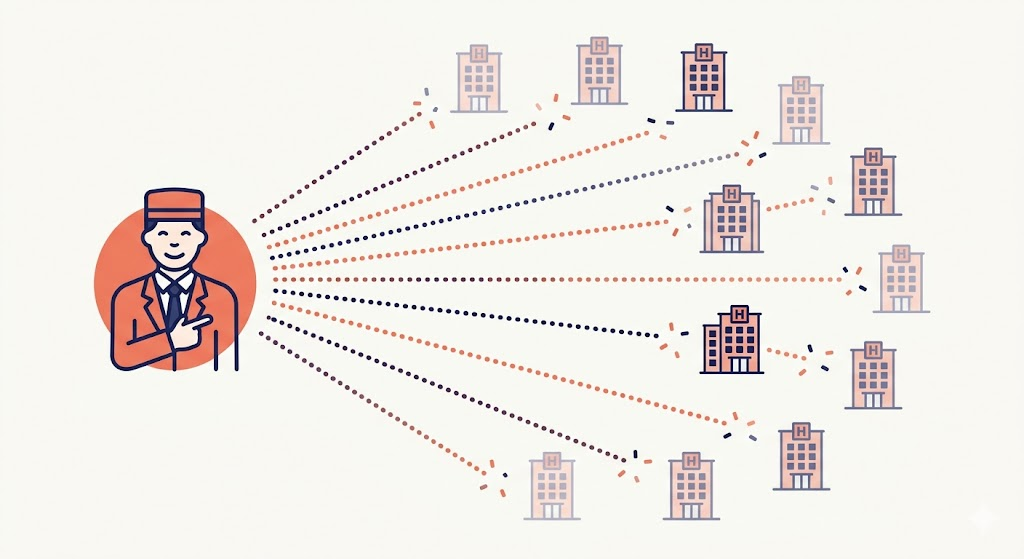
When you only own or operate one property, you can rely entirely on human talent. If you have an incredible GM or a rockstar Front Office Manager who knows every guest, every review site, and every local issue by heart, manual oversight works just fine.
But you cannot clone your best GM.
The moment your portfolio expands, that reliance on individual effort completely collapses. Decentralized teams start handling guest communications with no shared baseline.
Here is the real danger: a localized service failure at one location will instantly bleed into your global brand perception.
Today’s travelers are smart. They don’t view your properties as isolated businesses. If your downtown property has a reputation crisis, it directly colors how travelers perceive your property three states away.
If you are currently managing more than one property on a legacy platform, these four bottlenecks will sound very familiar:
- Inflexible Collection & Light Monitoring: Legacy tools limit you to basic monitoring and rigid, boring review surveys. You can’t gather feedback the way your guests actually want to give it, forcing you to choose between overburdening your staff or relying on robotic AI bots that ruin your brand voice.
- Cumbersome Management & Tech Fatigue: Cluttered interfaces bucket deep human emotions into dry, academic definitions. Instead of giving your team clear answers, they force them to spend hours digging through analytics screens.
- Fragmented & Inconsistent Data Integrity: Reviews and scores live in separate, siloed logins. A massive breakdown in legacy systems is poor data integrity — where your regional averages quietly mismatch your property-level data, forcing your corporate team to waste time reconciling numbers by hand.
- Rigid Ecosystems: Legacy software forces your hotels to conform to their tech stack. If you acquire a new property running a different Property Management System (PMS), syncing your data turns into an expensive IT nightmare.
This isn’t a failure of effort from your team. It’s a failure of your tools. Legacy platforms simply weren’t built to handle scale.
Why Multi-Property Hotel Reputation Management Fails Without Portfolio-Wide Governance
When you manage a portfolio, you don’t just need “the same tool with more logins.” You need a completely different architecture. Most platforms just give you a combined, flat list of properties.
That is not portfolio governance.
To win your market, your system needs six core, structural capabilities:
1. AI-Assisted, Outcome-Based Automation: Results That Don't Require Staff Time
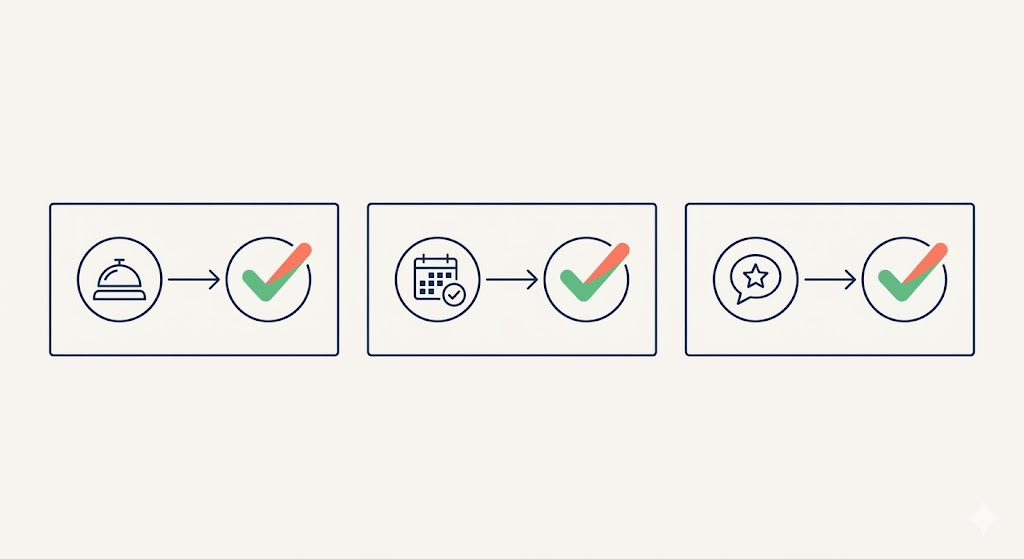
Legacy reputation platforms are capability tools — they give your team the ability to respond to reviews or send surveys. But “the ability to do it” means an employee still has to log in, remember to act, and find the time to execute.
In an industry where labor is your highest operational expense, that dependency is a massive hidden tax that compounds with every property you add.
GuestTouch is built around outcomes, not just capabilities. Review response needed that is optimized for LLMs? It’s automatically routed, drafted, and delivered with your brand voice, trust and staff authenticity — without a GM manually checking a queue, while having full control over the final output.
Monthly portfolio report due? It’s automatically generated and sent to the right audience at the right cadence. Post-stay survey for last night’s checkout? Your PMS triggers it the moment the guest departs, without anyone on your team touching a button.
The outcome happens. Full stop.
2. Custom Groups That Mirror Your Org Chart

Every management company organizes its business differently — by brand, region, asset tier, or ownership group. Legacy systems just give you an alphabetical list.
A true multi-property platform lets you define your own custom groups so your dashboard actually reflects how your VPs and Brand Directors operate, instead of forcing your org chart to conform to the software.
A regional VP doesn’t want a flat list of forty properties. They want their region. A brand director wants their brand, across every market it operates in, regardless of geography.
Custom grouping is what makes a portfolio-wide tool feel purpose-built rather than retrofitted.
3. Granular, Role-Based Access

Your GMs, regional directors, and executive teams need entirely different views of the same data — and different permissions on what they can act on. GMs need to manage their specific asset. Regional VPs need to drill into their specific territory.
Executives just want the macro roll-up, not the daily noise.
Without granular access controls, the only options are “everyone sees everything” (which buries people in irrelevant data) or “everyone gets their own siloed login” (which recreates the fragmentation problem all over again).
The fix is access scoped by role and by group — from the same system, without anyone needing standing access to data outside their lane.
4. Granular Operational Insights
A portfolio summary that only shows an average score is virtually useless. Averages hide the single underperforming property that is quietly dragging down your group revenue — and they hide the property doing something right that the rest of the portfolio should be learning from.
You need a system that lets you zoom from a 30,000-foot portfolio view down to a specific property, platform, or recurring complaint theme in two clicks.
This is where operational patterns surface: if three properties in a region are independently generating complaints about slow check-in, that’s a regional training issue you’d never catch reading each property’s reviews in isolation.
5. Location-Specific Competitive Sets
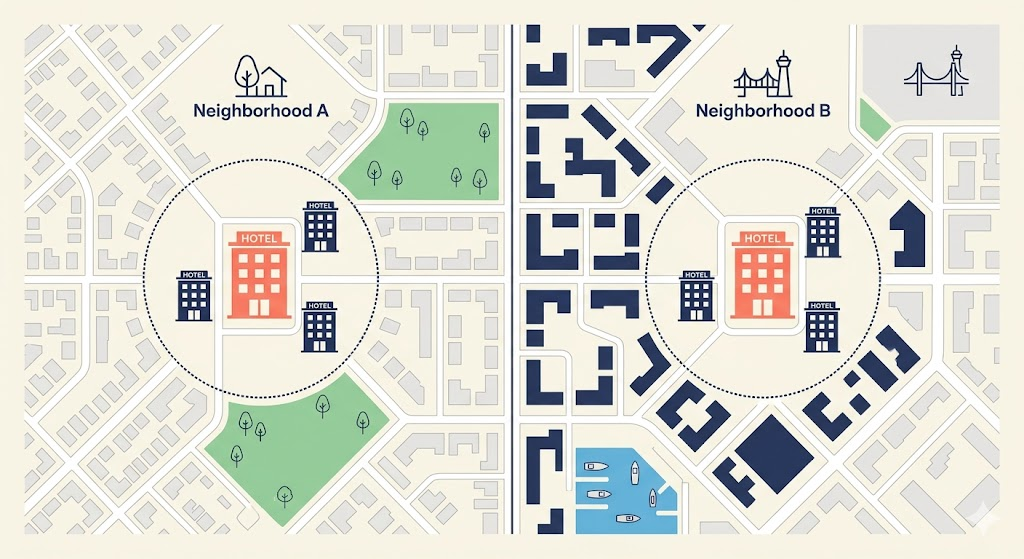
A select-service suburban property and a luxury downtown boutique are not competing for the same guest, even if they sit within the same management portfolio. Benchmarking them against a generic portfolio average tells you nothing useful — a property can look like it’s underperforming the portfolio average while actually beating every real competitor in its own market.
Each hotel needs its own local comp set — the specific street-corner competitors it actually competes with for the same guest, in the same market.
This is the difference between “your score is 4.3” and “your score is 4.3, which puts you second in your comp set.” The second version is the one that actually changes a GM’s priorities.
6. Portfolio KPIs Leadership Will Actually Read
The moment reporting requires manual assembly, it gets skipped under deadline pressure — and the portfolio loses its early-warning system right when it matters most.
Your system should automatically track a small, powerful set of core KPIs — average score by property and by region, response rate and response time, review volume trend, Guest Emotional Drivers™, and movement against comp set — and deliver them to the right audience on autopilot.
The goal isn’t more data. It’s the right handful of numbers, sliced by the groupings that matter, delivered without anyone having to assemble it manually.
The GuestTouch Solution: Why an Adaptive Reputation Engine Beats Rigid Hotel Software
Most reputation tools on the market are monolithic and rigid. Every property gets the exact same dashboard, channels, and reports, whether it’s a 12-room boutique or a 400-room convention hotel. The platform doesn’t change shape.
The people using it do all the adapting themselves — filtering, exporting, reformatting — which is exactly the manual overhead a portfolio system was supposed to eliminate.
GuestTouch is built on the exact opposite premise. The Adaptive Reputation Engine reshapes itself around your environment, your properties, and your individual user roles — monitoring, flagging, and routing automatically rather than waiting for your team to pull the data.
It connects directly to your PMS to completely automate your backend workflows, freeing your team from managing the software so they can focus on the guests.
- For Corporate Teams: It turns raw review volumes into clean, automated hotel portfolio performance analytics categorized by ownership group, asset class, or region — without losing backend data integrity.
- For Property GMs: It strips away corporate noise, surfacing a tailored dashboard focused entirely on immediate, daily workflows like unanswered reviews and flagged guest issues — so nothing falls through between shifts.
- For Regional VPs: It ditches generic national averages and extracts deep, hyper-localized insights against each property’s actual street-corner competitors. If a property is lagging its local comp set due to service speed at check-in, the platform flags it as an operational risk before it compounds into a rating drop.
Here is exactly how the GuestTouch Adaptive Engine stacks up against legacy platforms:
Rigid model: one dashboard, one channel list, one report, for everyone.
Adaptive Reputation Engine: the dashboard, the channels, the feedback methods, and the report all reshape around the property and the person looking at them — without losing one consistent, trustworthy source of data underneath.
Eliminating Cognitive Strain: The KPIs That Actually Matter — By Role
We built GuestTouch around a very simple design philosophy: the distance between curiosity and an answer should have the absolute least friction possible.
Your hospitality teams shouldn’t have to be data scientists to find actionable operational insights.
To eliminate cognitive strain, our dashboards automatically surface the exact answers your team needs to fix service gaps — before guests post a negative score online.
GM / Property Level: Actionable Operations

The property view is designed to provide complete operational clarity and daily peace of mind.
- Response Coverage Tracking: Instantly highlights unanswered feedback so GMs can guarantee a 100% response rate and no review slips through the cracks.
- On-the-Surface Guest Emotional Drivers™: Instead of making you dig through complex charts, the dashboard flags exactly what is triggering guest experiences — for example, “Front desk friendliness is up 14%, but breakfast wait times are causing friction.”
- Staff Performance Highlights: Tracks which specific team members or shifts are winning praise, making targeted coaching and internal recognition effortless.
VP of Operations / Regional Level: Pattern Detection
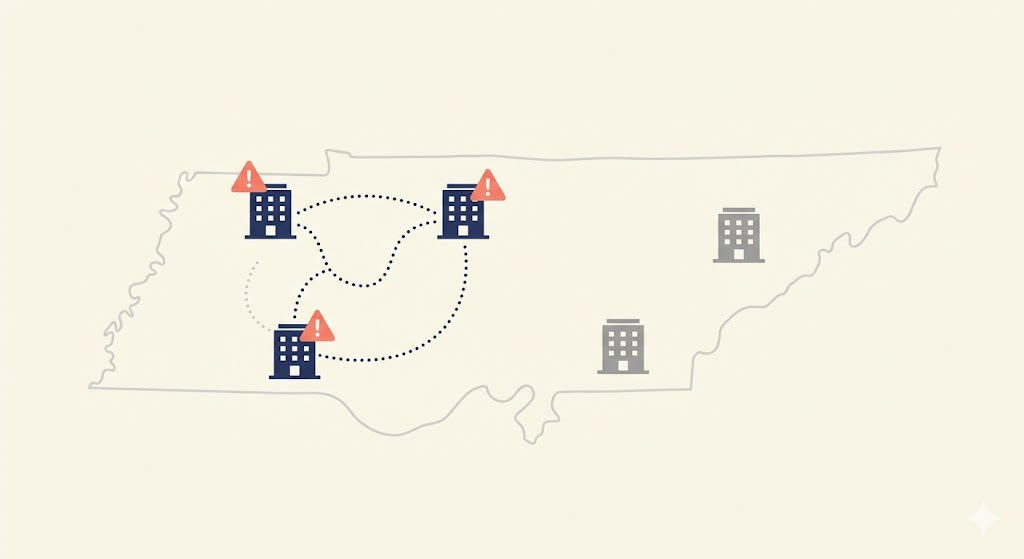
The regional view shifts the focus from individual reviews to larger operational patterns across your markets.
- Actionable Friction Flags: The system automatically groups recurring operational failures — housekeeping gaps, slow check-ins, F&B complaints — across the region, allowing VPs to step in and fix structural issues before they damage local market rankings and cost the brand stars, rank, and revenue.
- Comp-Set Performance by Market: Displays exactly how each property is performing against its true local street-corner competitors, showing you precisely which markets you are winning or losing and by how much.
Corporate / Executive Level: Brand Health at a Glance
Executives don’t have time for daily property noise. They need a high-level, blended scorecard that tells the true story of brand health instantly.
- Brand-Wide Score Trend: Portfolio average movement over time, explicitly paired with revenue-at-risk metrics attached to any decline.
- Portfolio-Wide Comp-Set Position: Aggregate performance metrics against your primary brand competitors across every market.
- Cross-Property Risk Flags: Automatic identification of underperforming assets or regions that require immediate executive resources — surfaced without anyone having to go looking for the problem.
A rigid, fixed model forces all three of these audiences to read the same report and extract what matters to them by hand. An adaptive model generates each view natively — same underlying data, three different altitudes, zero manual translation.
What to Ask Before You Choose a System
If you want to move away from a legacy platform to a system built for real portfolio operations, use this checklist. Ask any vendor these questions directly — the answers will tell you quickly whether the tool is genuinely purpose-built for multi-property management or a single-property platform being stretched past its limits:
- Can I group properties by my own custom structure — brand, region, or asset tier — rather than working from a flat list?
- Does the channel list and dashboard adapt per property, or does every hotel, regardless of size or guest profile, get the exact same fixed view?
- Does review collection flex per property — SMS, WhatsApp, QR codes, in-stay NPS — or is everyone forced into the same single intake method?
- Can I grant different roles different access and different KPI views — property, regional, and portfolio-wide — without giving everyone the same flat report?
- Can each property set its own local comp set rather than being benchmarked against a generic portfolio or national average?
- Does the platform surface Guest Emotional Drivers™ directly — what’s triggering guest anger, delight, or friction by department — without requiring your team to dig through reports?
- Does the software integrate adaptively with your specific PMS to automate workflows natively, or will someone on the team be maintaining that connection manually?
- Does reporting generate automatically per audience — GM, regional, corporate — or does someone rebuild it from scratch every reporting cycle?
If the answer to more than one of these is “not really” or “only with custom workarounds,” you are dealing with a rigid, single-property tool being stretched past its limits — which means your team will spend more time managing the software than driving guest satisfaction.
Own the Market on Every Corner

Reputation management stops being an administrative chore and becomes a core portfolio operating system the moment you scale past a few properties.
The hotel management groups that are absolutely dominating their markets today aren’t doing more work. They’ve simply stopped using clunky legacy tools and replaced them with an adaptive engine built to show the portfolio, the region, and the property all at once — without friction.
If you are ready to eliminate cognitive strain, automate your review workflows, and protect your portfolio’s room revenue, book a demo with GuestTouch today to see the Adaptive Reputation Engine in action, or start a free trial with your own properties right now.


Need Help ?
Talk to our Experts to supercharge your Pre-Arrival experience
Schedule Now
Posted on
June 22, 2026
Referenced GuestTouch Products
No items found.
AI generated responses for your reviews
Powered by Review Response AI

Get bright ideas and best practices delivered straight to your inbox
Stay up to date! Get all the latest & greatest posts delivered straight to your inbox
Don’t worry we won’t send you spam